Japan Solved Zoning in 1968 and Unfortunately Nobody Copied Them
Japan’s zoning is a masterpiece of public policy.
And I’m not being hyperbolic. I think if the rest of the world adopted Japanese zoning practices we’d have a much more stable, more balanced world.
Because what upsets people more than not being able to afford shelter... a basic need.
There’s a real argument to be had that the polarized world we live in is due in part to astronomically high housing and rental costs... which are a direct result of very strict, exclusionary zoning laws in western countries.
I don’t want to get too political though, so let’s dive into Japanese zoning... why it’s so magical, and how to actually understand it.
So. Japan’s national government sets the zoning. There are thirteen zones. Same thirteen across all of Japan, Tokyo, Otaru, a village of four hundred people. Local governments have some power to shape how things play out inside those zones, but they can’t change the basic structure of the zones themselves.
An eighty-five-year-old man on a local town board does not have the power to decide where someone can open a coffee shop. A planner at the national level already made that call.
So here are the thirteen:
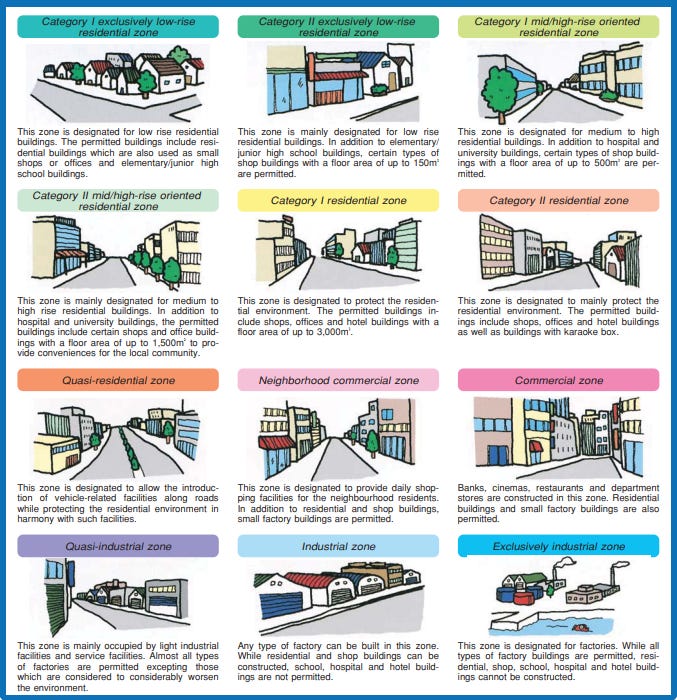
Eight residential zones:
Category one low-rise exclusive residential.
Category two low-rise exclusive residential.
Category one mid-to-high-rise exclusive residential.
Category two mid-to-high-rise exclusive residential.
Category one residential.
Category two residential.
Quasi-residential.
And agricultural residential, added in 2018.
Two commercial zones:
Neighborhood commercial.
And commercial.
Three industrial zones:
Quasi-industrial.
Industrial.
And exclusive industrial.
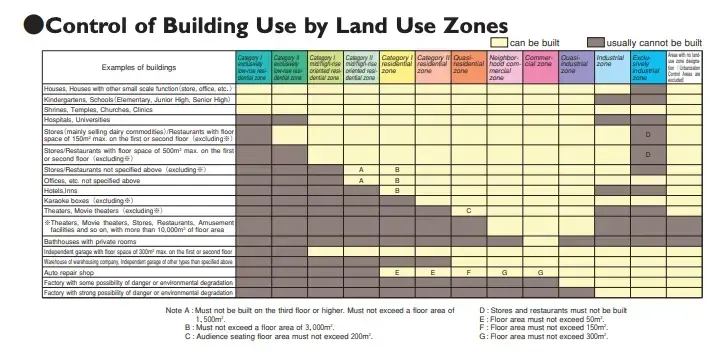
And I mean almost every one. Even in category one low-rise exclusive residential, the single most protected zone in Japan, the equivalent of an American single-family neighborhood, you can run a café out of your house. The shop part has to stay under fifty square meters and the house has to be at least half the building. But you can do it. In an American R-1 zone you can’t run anything.
There’s also no national design review. Nobody telling you what color your house can be, no HOA, no architectural committee. Kyoto and a handful of scenic districts have landscape rules but those places are the exception.
And minimum lot sizes barely exist. Local governments can set one, but national law caps that minimum at two hundred square meters. That’s the maximum minimum. Meanwhile a quarter-acre minimum is standard in American suburbs and that’s a thousand square meters. Five times bigger than anything Japan will let a town require.
So plots have been subdivided over the years into smaller and smaller lots. Which creates these densely packed, walkable, commerce-filled neighborhoods and keeps supply high so housing doesn’t get insanely expensive.
The fact that you can build commercial space in most zones means people can start a passion project for way cheaper than in any western country. And it means you can walk around your neighborhood, get everything you need, and build actual connections and community.
Now, as a foreign buyer, it’s not important to memorize thirteen zones. The main thing you need to know is where you can rent, where you can’t, and what license you can get in each.
Ryokan licensing is standard across the board. It’s national law. You can get it in six zones: category one residential, category two residential, quasi-residential, neighborhood commercial, commercial, and quasi-industrial.
A ryokan license lets you rent three hundred sixty-five days with no restrictions. You have to meet the local government’s code requirements, pass a fire inspection and a public health inspection. We recommend all our clients go for this license, because it’s stable, it’s long-established, and it is not the target of the current administration.
Minpaku is not standard across the board. Each local government can shape where you can get it, how many days you can rent, what zone you’re in. It’s already capped at a hundred eighty days at the national level, and then it’s often restricted further at the local level.
And as of July 2026, the Japan Tourism Agency told local governments they can set that number to zero. Zero days. Which is a flat out total ban. The national guidance used to say zero-day ordinances were not appropriate, but here we are and I guarantee you some municipalities are going to do it.
That’s why we steer clients away from minpaku licensing.
Now, in any zone in Japan you can rent long term. Thirty days or more. The guest signs a real lease, & they get a 重要事項説明, explanation of important matters, where certain things about the contract have to be verbally walked through. That can be done over video call. We’re currently building a system to streamline all of this.
So if you own a home in a restricted zone, we can still advertise it for month-long stays. Honestly, I think it’s a great option for people who don’t want the headache of the licensing process.
If you want a true STR with the ability to rent your house on Airbnb, VRBO, Rakuten Travel, Booking, Google travel (I think I named them all), focus on Ryokan eligible zones. Avoid Minpaku in 99% of cases. And if your okay with less demand but still want someone visiting your house to offset the costs, do month-to-month.
Thats my spiel!
Browse opportunities yourself: Check out current listings at Nipponhomes.com
Book Consultation | Subscribe to our newsletter
We’ve been building out a solid list of travel + ski partnerships lately.
If you’re gearing up for a trip and need things like luggage, Goggles, insurance and much much more there are some really good deals below.
We’re always looking to partner with great travel + ski brands.
If you’d like to be featured on our perks page or partner with us, reach out here:
This content is for informational and educational purposes only and reflects my personal opinions and experience. I am not a licensed financial advisor, tax advisor, or attorney. Readers should conduct their own due diligence and consult qualified professionals before making any investment decisions.

Take the Next Step
Join our community for exclusive insights and resources on Japanese real estate investments.

Our team
Meet the founders.

Derek has been working in the Airbnb space for the past 10+ years and recently purchased a home in Japan. He is excited to bring this investment opportunity to others in the States & abroad.

Nick has a passion for adventure and has always dreamed of owning a property in Japan. His dreams finally came true when Derek brought him in on a deal of a lifetime in Hokkaido, Japan - one of Nick's favorite places on Earth.