
What is FIRE (and why everyone’s chasing it)
If you’ve been living under a rock, FIRE stands for Financial Independence, Retire Early. The idea is simple: save and invest aggressively until your investments cover your living costs, then work only if you want to.
Most FIRE plans use the “4% rule.” Multiply your annual spending by 25, and that’s your target portfolio. Spend $60,000 a year and you need $1.5 million invested. Spend $40,000 and you need $1 million.
That math hides the real lever. Earning more helps, but cutting what life costs you shrinks the finish line itself. And that’s where Japan comes in.
We call it Japan FIRE: owning a home in Japan, living there for part of the year, and letting the country’s low costs do the heavy lifting on your retirement number.
The problem with classic FIRE: your number is too big
In much of the US, housing alone eats a huge share of the budget. Add health care, groceries, car payments and insurance, and “lean” FIRE still lands well north of $1 million for many people.
The usual fixes are painful. Move somewhere cheaper full-time, cut your lifestyle to the bone, or work ten more years. Most people stall out somewhere between “almost there” and “maybe never.”
Geographic arbitrage, earning or saving in a strong currency, spending in a cheaper place, is the classic workaround. Japan FIRE is a version of it that doesn’t require giving up your home country.
Japan FIRE: the half-year model
Japan FIRE splits your year in two. You keep your life at home, and you spend long stretches in a house you own in Japan, think a ski season in Hokkaido and a summer or fall on the coast.
Citizens of the US, UK, Canada, Australia and most of Europe can visit Japan visa-free as temporary visitors, typically for up to 90 days per entry. Two long stays a year puts you in Japan for half the year.
Here’s why that changes the math:
- Your Japan months cost a fraction of your home months. Groceries, eating out, transit and utilities are dramatically cheaper than in most US cities.
- You already own the roof. No rent, no hotels, no Airbnb bills of your own. Countryside houses in Japan often sell for less than a used car.
- Holding costs are tiny. Annual property tax on a rural Japanese house is often a few hundred dollars.
- The house can pay for itself. Rent it out while you’re away and the income can offset, or exceed, what it costs to own.
If half your year costs half as much, your total annual spending drops sharply. Since your FIRE number is 25 times your spending, every dollar cut per year is $25 you don’t need to save.
The math: what Japan FIRE does to your number
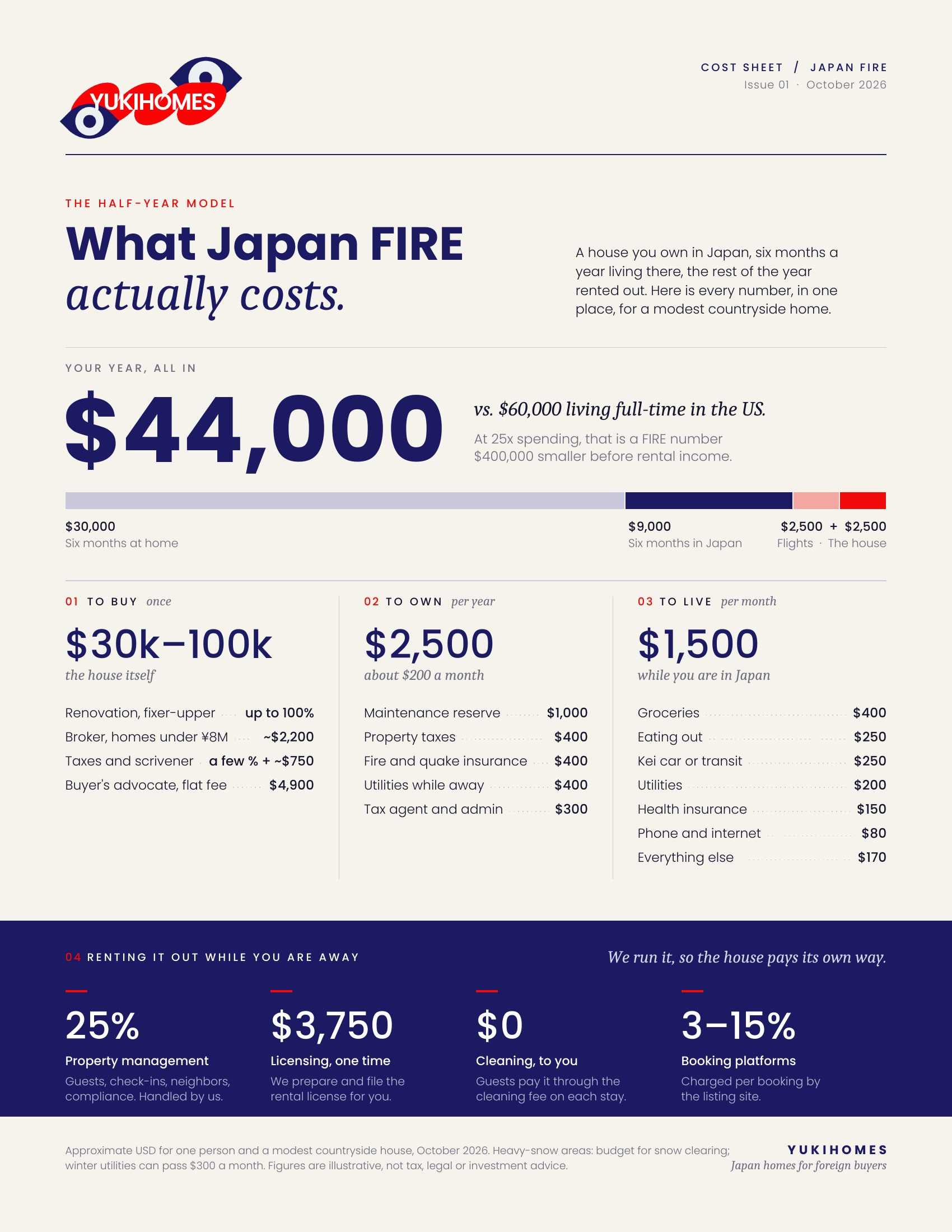
In this illustrative example, Japan FIRE cuts a $1.5 million FIRE target to roughly $1 million. Your numbers will differ, but the shape holds.
Buying the house. Japan has millions of vacant homes (akiya), and rural or small-city houses regularly list for $30,000–$100,000. Ski-town and coastal properties with rental potential cost more, but still far less than comparable US vacation homes.
Owning the house. Annual fixed asset tax is 1.4% and city planning tax up to 0.3% — but of the government’s assessed value, which is usually well below the purchase price. On a modest countryside house, that’s often a few hundred dollars a year. Fire and earthquake insurance typically adds a few hundred more.
Living there. A couple living simply in rural Japan can cover food, utilities, phone and local transport for around $1,500–$2,000 a month.
One honest caveat: this works best when your home-country costs actually drop while you’re away. If you’re paying full rent or a big mortgage in the US year-round, your savings shrink. Owners who’ve paid off a home, downsized, or rent out their US place while in Japan get the biggest boost.
Rent it out while you’re away
The months you’re not in Japan are the months your house can earn. In ski towns like Otaru, Asahikawa, Myoko or near hot springs like the Izu Penisula and the coast, short-term rental demand from domestic and international travelers is strong.
There are three main ways to do it legally:
- Minpaku (private lodging) registration. The simplest route, but capped at 180 nights a year, and some towns restrict which days or zones are allowed.
- Simple lodging (ryokan/hotel) license. No 180-night cap, but stricter building, fire-safety and zoning requirements.
- Monthly rentals. Stays of 30+ days on a fixed-term lease sit outside short-stay lodging rules, and suit remote workers and long-stay skiers.
If you live overseas, Japanese law requires a registered property management company to run a minpaku when the owner isn’t on site. We help with that and manage clients properties. We charge 25% of gross revenue and its completely hands off for you.
Even a modest rental income often covers your property tax, insurance, utilities and management, meaning your Japanese home costs you close to nothing to hold.
The fine print: visas, taxes and insurance
Japan FIRE is powerful, but it only works if you do it by the rules. Here’s what to know before you buy.
Visa-free stays are for visiting, not living. Owning property in Japan does not give you any right to reside there. Spending close to half the year in Japan, year after year, can draw questions at the border, so keep strong ties at home, a return ticket, and a clear tourist purpose. You also can’t work in Japan on visitor status.
A new pre-travel step is coming. Japan’s electronic travel authorization, JESTA, is targeted for fiscal year 2028 and will require a new authorization for each entry (Passport Index, Legit.ng). It doesn’t end visa-free travel, but plan for it.
Taxes in two countries. Rental income is taxable in Japan, and US citizens must also report it to the IRS, usually with foreign tax credits. Talk to a cross-border tax professional.
Health insurance. Visitors aren’t covered by Japan’s national health insurance, so you’ll need travel or international health coverage for your stays.
The house itself. Many cheap houses are old, built before Japan’s 1981 earthquake code, or need snow, roof and plumbing work. Resale can be slow in rural areas. Get an inspection and budget for repairs before you call it a bargain.
How to start your Japan FIRE plan
- Run your own numbers. Split your annual spending into home months and Japan months, add flights and ownership costs, and multiply by 25.
- Pick a region that fits both halves of the plan. You want somewhere you love living and somewhere guests want to visit, such as Hokkaido ski towns, Nagano, or coastal and onsen areas.
- Check rental rules before you buy. Confirm zoning and whether minpaku, a lodging license or monthly rentals are allowed at that address.
- Line up your team. A buyer’s agent who speaks English, a licensed management company, and a cross-border tax advisor.
- Do a test stay. Spend a season in the area before committing.
At Yukihomes, we help foreign buyers find, negotiate and close on homes in Japan for a flat fee, and our sister company can manage the rental side while you’re away. Sign up for our free weekly newsletter, Bento Box, for three hand-picked Japanese homes in your inbox every week.
Japan FIRE FAQ
Can foreigners buy property in Japan? Yes. Japan has no restrictions on foreigners owning land or houses, and you don’t need residency to buy.
Does owning a house in Japan give me a visa? No. Property ownership doesn’t grant residency. Most Japan FIRE buyers visit on visa-free short stays of up to 90 days per entry.
How much is property tax on a house in Japan? Fixed asset tax is 1.4% and city planning tax up to 0.3% of the assessed value, which is usually far below market price. Rural homes often pay a few hundred dollars a year.
Can I Airbnb my house in Japan? Yes, if you register it legally. Minpaku registration allows up to 180 nights a year, and overseas owners must use a registered management company.
Is Japan FIRE cheaper than retiring in the US? For many people, yes. Lower living costs for part of the year, minimal holding costs and rental income can cut your FIRE number by hundreds of thousands of dollars
Ready to buy a house?: Book a call here
Browse opportunities yourself: Check out current listings at Nipponhomes.com
We’re always looking to partner with great travel + ski brands.
If you’d like to be featured on our perks page or partner with us, reach out here:
This content is for informational and educational purposes only and reflects my personal opinions and experience. I am not a licensed financial advisor, tax advisor, or attorney. Readers should conduct their own due diligence and consult qualified professionals before making any investment decisions.

Take the Next Step
Join our community for exclusive insights and resources on Japanese real estate investments.

Our team
Meet the founders.

Derek has been working in the Airbnb space for the past 10+ years and recently purchased a home in Japan. He is excited to bring this investment opportunity to others in the States & abroad.

Nick has a passion for adventure and has always dreamed of owning a property in Japan. His dreams finally came true when Derek brought him in on a deal of a lifetime in Hokkaido, Japan - one of Nick's favorite places on Earth.